In the disgraceful tradition of My Lai and Abu Ghraib, America again shows the world its dark side.
|
Listen To This Story
 |
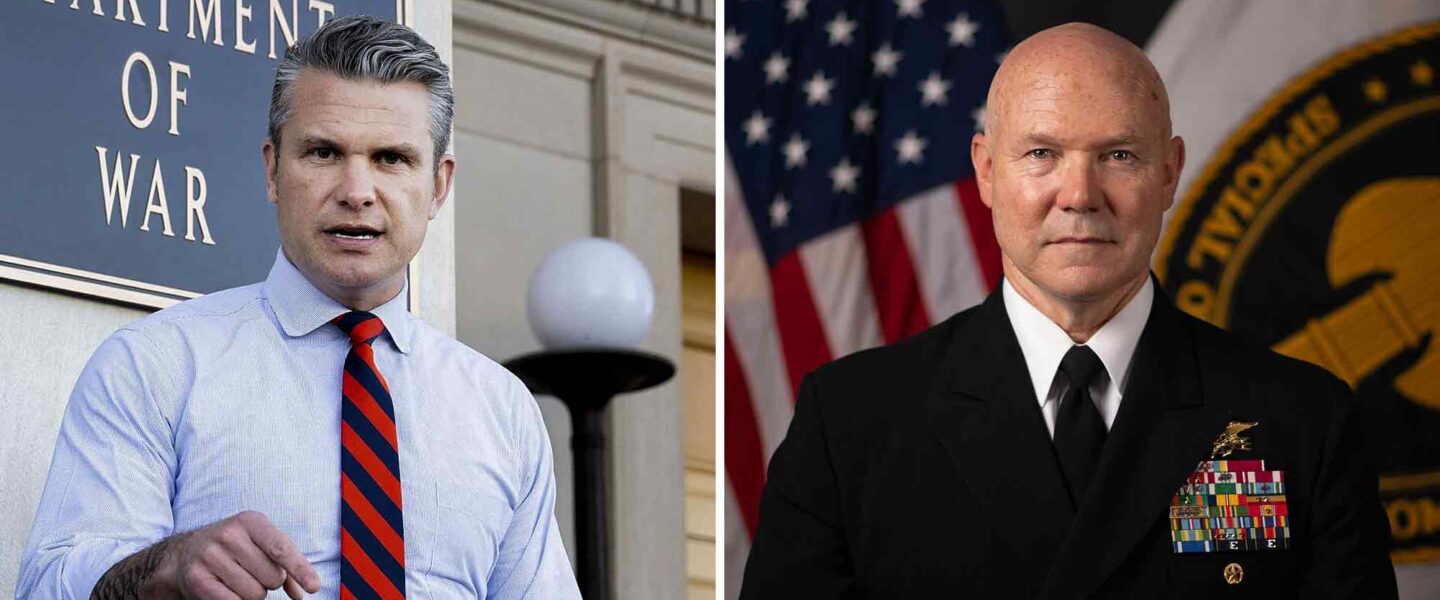
Pete Hegseth, the US secretary of defense, may think that the Geneva Conventions are a joke. He is wrong.
It seems that he and his nominal commander in chief have a shaky understanding of the basic logic that makes the American government and, for that matter, the world function.
When six Democrats in Congress produced a video reminding members of the US military that they are not obliged to obey illegal orders, the lawmakers were simply repeating an important principle that is prominently embedded in the Uniform Code of Military Justice (UCMJ), the system of laws that renders the US military coherent and able to function.
The warning against following illegal orders was couched in general terms, but on Friday, November 28, The Washington Post reported that on September 2, the US had not only destroyed a boat suspected of carrying drugs, but had then returned to the boat’s burning wreckage and spotted two survivors of the initial attack. The Post cited two sources who said that they had been in on the operation.
According to their account, the strike team had asked what to do about the survivors desperately clinging to the boat’s wreckage. They reported that Hegseth’s answer was to kill them all. The result was a second strike, which did just that. If the Post’s account is true, the order was in clear violation of the Geneva Conventions and international law as well as the UCMJ.
The UCMJ mandates that military personnel refuse to follow an order that violates the US Constitution, involves the commission of a crime, or violates international law. The reason those rules exist has a great deal to do with the war crimes trials at the end of World War II.
The acts perpetrated by Nazi officers — especially those in the Waffen SS, Hitler’s private militia — were so heinous that it was impossible to let them go unpunished. In their defense, Nazi officers claimed that they were simply “following orders” when they murdered 6 million Jews, not to mention thousands of other individuals that Hitler’s Reich considered inferior to his conception of a master race.
Normally, US legal thinking holds that a specific law needs to be on the books before anyone can be convicted of a crime. You cannot simply convict someone “ex post facto.” If a law forbidding the act did not already exist before a crime was committed, the perpetrator cannot be prosecuted after the fact. The post-war trials proved an exception to this.
In the case of the Nazis, the Allied Powers — and especially the US — decided that simply “following orders” could not be used as an excuse. Their conscience-harrowing guilt was considered too obvious to be ignored. The worst of the Nazi offenders were hanged. The rule that “following orders” could not be used as an excuse for committing an outrage in war or against humanity was prominently written into America’s UCMJ.
Of course, no one is likely to compare Hegseth to the worst of the Nazi war criminals, but the slope from violating civilized norms to becoming a monster is slippery. What looks like a bold action today may cross the line into an atrocity before anyone, including the perpetrator, realizes the extent of what is happening.
In the case of the alleged Venezuelan narcotics smugglers, the justification for blowing the boats out of the water without first stopping and investigating what they are actually doing is questionable at best. The US Navy is more than capable of intercepting and boarding boats coming from Venezuela and determining whether they are actually carrying drugs. In fact, the US Coast Guard has been carrying out this duty with admirable efficiency for more than a century.
Drug trafficking is reprehensible, but it cannot seriously be called terrorism, except by a wild stretch of the imagination. No matter how much fentanyl — or, in this case, probably cocaine, a far less dangerous drug — it carries, a high-powered speed boat hardly represents a direct threat to the United States.
The real reason for using aircraft or drones to bomb the boats is either to avoid the legal red tape involved in arresting a suspect in international waters or to terrorize the Venezuelans into avoiding the ocean altogether. In the latter case, it is Hegseth who is the real terrorist, not the hapless drug smugglers, however reprehensible they might be.
And once the boat had been destroyed in the September 2 attack, there was no possible excuse for killing the two survivors clinging to the wrecked hull. That is the equivalent of shooting a prisoner of war in cold blood.
The situation is further complicated by the fact that the Trump administration asserts that we are not officially at war with Venezuela or the drug smugglers. Going to war still technically requires a declaration of war — or at least some formalized signal of intent or approval — from Congress, and Trump is not prepared to seek that.
We will probably never know whether the killing of the two Venezuelan survivors of the September 2 US attack was carried out on specific orders from Hegseth or instead resulted from someone taking one of Hegseth’s careless comments to its natural conclusion.
Hegseth left no doubt that he was in complete agreement with the attack when he jokingly posted a cartoon on X over the weekend. The drawing shows a familiar cartoon figure, Franklin the Turtle, firing a rocket grenade at Venezuelan speed boats from a Vietnam-era US “Huey” (UH-1) helicopter. The title reads “Franklin targets narco-terrorists.”
Since the flap over what some see as the murder of foreign nationals, the White House has tried to justify the assaults against what it claims are “narco terrorists,” while quietly shifting the blame from Hegseth to the commander of the operation, Vice Adm. Frank “Mitch” Bradley, who, the White House suggests, may have misunderstood Hegseth’s orders.
Hegseth and Trump no doubt hope that Bradley will graciously agree to fall on his sword, a tradition in ancient Rome, when commanders were required to commit suicide to absorb the shame of their superior officers.
The men and women who staff the Pentagon know differently. Failure to take responsibility for a command decision amounts to cowardice — and cowards are useless as leaders. What we now know at the very least is that Hegseth is manifestly unqualified to serve as head of the US military.
He may have deluded himself into believing that he is a “warrior,” but the fact is that he was never part of the US Army. He did serve in the National Guard, basically an auxiliary state militia, where he reached the mid-level rank of major, but he had no comprehensive command experience, certainly not at the level required to manage a massive organization such as the Pentagon.
When the US Army promotes officers to the rank of general, it usually first sends them to the US Army War College or for advanced post-graduate training in order to broaden the officer’s vision and polish their talents. Hegseth had none of that. What he was, in fact, was a weekend TV anchor on Fox News. The cluelessness that led to the Signalgate fiasco in March 2025 showed that when it comes to national security, Hegseth is still a rank amateur.
The most disturbing aspect of the whole affair, however, is Hegseth’s readiness to kill even when it is not necessary. Shooting people or blowing things up may sound exciting to TV viewers — it’s how Hollywood sees the military — but the military’s real function is to project power when and where it is needed. The object is to show power without having to use it, except in extreme situations.
The Geneva Conventions trace their roots back to the Battle of Solferino in 1859, when 130,000 troops under Napoleon III joined Sardinians under their king, Victor Emmanuel II, and fought an Austrian army under the Austrian emperor, Franz Joseph I. The battle left unspeakable carnage in what had until then been a peaceful mountain village. A Swiss businessman, Jean-Henri Dunant, organized the villagers to help the wounded and dying. He later expressed the trauma he had experienced in a book entitled A Memoir of Solferino.
The book led to the founding of the International Committee of the Red Cross in Geneva, and eventually to treaties in which competing powers agreed that there were certain lines of inhuman behavior that no one should cross, even in warfare. This opened the way to a steadily expanding body of international law designed to avoid warfare whenever possible, and to mitigate suffering if war did break out. Needless to say, though it may have escaped Hegseth’s notice, among those protected by those laws are American servicemembers.
It is that larger body of law, as well as the specific Geneva Conventions — and in the end, the imperatives of basic human decency — that Pete Hegseth and Donald Trump would carelessly cast aside. They do so at their own and at our peril.